This Man, Explained: The Face Everyone Dreams About — and How to Draw Him
Search “this man” and you’ll find the same middle-aged face everywhere: heavy brow, deep-set eyes, a flat wide nose, an expression that is somehow both anonymous and unforgettable. Thousands of people across dozens of countries swear they’ve seen this exact face in their dreams. Some report him for years before ever seeing the picture.
So what is going on? Is this a real person? A shared dream? Here’s the honest answer — and, at the end, something more useful: how you can draw a face like this yourself, using proportions anyone can learn.
In this article
- 1. What ‘This Man’ actually is
- 2. Where the face came from
- 3. Why he feels so familiar (the real reason)
- 4. The anatomy of an ‘uncanny familiar’ face
- 5. Draw him yourself — or invent your own
- FAQ
- Sources
1. What ‘This Man’ actually is
This Man — often called the Dream Man — is not a real person and not a supernatural phenomenon. He is a conceptual art project and an internet hoax. There is no evidence that people genuinely share dreams about the same face. What is real is the psychology: once you’ve seen this particular illustration, your brain becomes very good at “recognizing” it in the blurry material of your own dreams. That loop, not magic, is what made the meme explode.
Everything below is the documented backstory plus the cognitive mechanisms that explain why it worked on so many people.
2. Where the face came from
The project was launched in 2008 by Andrea Natella, an Italian sociologist and marketing consultant. He put up a website titled “Ever Dream This Man?” that invited visitors to submit stories about a mysterious figure appearing in their sleep. The site displayed a single hand-drawn portrait and framed the submissions as evidence of a worldwide phenomenon.
A few details that cut through the mystery:
- The face is an illustration, not a photograph. By Natella’s own account it was drawn from a portrait of his own father — which is exactly why it looks like a plausible “anyone” rather than a specific celebrity.
- The “thousands of dreamers” were self-selected. The website only published the reports that fit the premise. No controlled study ever verified a shared dream.
- It was a deliberate social experiment in viral spread. Natella later continued the narrative with a follow-up project called “DREAMER.” The point of the stunt was to watch a single image become a global legend.
The legend then did what legends do. It spread on its own through Reddit’s dream forums, YouTube explainers, and later TikTok, Facebook, and Instagram — each new wave of “I’ve seen him too!” posts feeding the next. The more people insisted it was real, the more believable it became. Debunking it only added oxygen.
3. Why he feels so familiar (the real reason)
This is the genuinely interesting part, and the reason the hoax landed. A handful of well-studied brain habits team up to turn “I saw a random man” into “I’ve seen this man in my dreams for years.”
| Mechanism | What your brain does | Why it makes This Man work |
|---|---|---|
| Priming / power of suggestion | Being told “you may have seen this face in dreams” plants the search task. | You start looking for him in memories you’d never have examined otherwise. |
| False memory & source-monitoring error | The brain mislabels where a memory came from. | A face you saw while awake gets re-filed as a face you “dreamed.” |
| Confirmation bias | You keep the hits and discard the misses. | Every vague resemblance counts as proof; every non-match is forgotten. |
| Dream faces are composites | Dreams reuse fragments of familiar people, not new renders. | A generic middle-aged male is easy to match against almost anyone’s dream imagery. |
| Pareidolia + averaging | You impose a known pattern on fuzzy input. | The blurrier the memory, the more readily it snaps to a template you’ve seen. |
The key insight: dreams rarely invent wholly new faces. They recombine features of people you’ve actually met. So a deliberately average face — one that sits near the “mean” of many real male faces — will overlap with a huge number of people’s dream fragments. That is not a haunting. It’s statistics meeting memory.
4. The anatomy of an ‘uncanny familiar’ face
Now look at the drawing as a student of faces would. Nothing about This Man is extreme. His “creepy familiarity” comes from the opposite: he’s close to the average, which is exactly what makes him fit so many people’s memories.
What you’re actually seeing, in proportion terms:
- A standard vertical split. Forehead, brow-to-nose, and nose-to-chin thirds are near-equal — the textbook front-view head. This normalcy is why he reads as “real.”
- A heavy brow line and deep-set eyes. The eyebrows sit low and thick over the eye line, which our brains tag as intense or threatening. That’s the only real “off” note, and it’s the source of the unease.
- Eyes near the vertical midpoint of the head. Beginners always place eyes too high; correct placement (eyes at roughly half head-height) instantly looks more authentic.
- A wide, flat nose and a mouth that isn’t too full. Both are pulled toward the average, reinforcing the “everyone / no-one” effect.
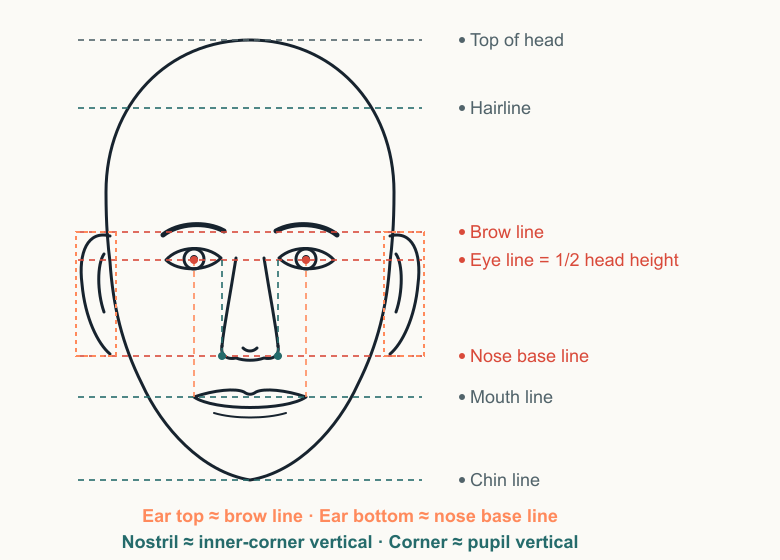
The features line up on ordinary landmarks — inner eye corners to the nostrils, pupils down to the mouth corners. Average placement is why This Man feels like someone you know.
There’s an entire field behind this: face averageness (composite “saver” faces) tends to look familiar precisely because it shares information with every face in the group. This Man is a hand-drawn accident that lands on the same principle.
5. Draw him yourself — or invent your own
Here’s the part that matters for you. A face like This Man isn’t magic — it’s just proportions plus a couple of exaggerations (the low brow, the deep-set eyes). Once you can place the features on a head, you can build any face: a “dream man,” a character, a self-portrait.
The whole trick is where things go, not how neatly you draw them. The beginner’s guide to face proportions walks through the three thirds, the five-eye rule, and the alignment landmarks step by step. Followed at face value, that 8-step workflow gets you from a blank page to a front-view head with every feature in the right place:
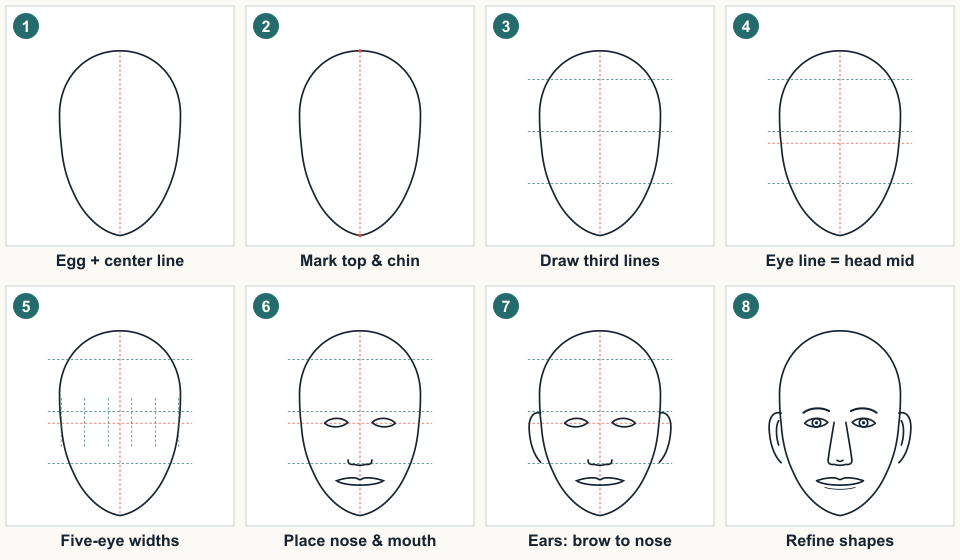
Egg shape and center line, then the two third-lines, the eye line, the five-eye widths, then nose, mouth, and ears — refine last. Add a heavy brow and you’re already at This Man’s door.
And if you’d rather see the proportions move than draw them freehand, that’s exactly what our tool is for. In the FlashFace online face maker you drag the same landmarks — brow line, eye line, nose and mouth position — and watch a face change in real time. Nothing to install: the maker is built right into the Flash Face homepage, so you can go from reading this to moving the first landmark in a single click. It’s the fastest way to feel why dropping the brow two millimeters turns a friendly face into the guy everyone dreams about. Make your own “This Man,” or one nobody’s ever reported dreaming.
Try this: open the face maker, start from an average face, then push the eyebrows down and in and set the eyes deep. That one change is the difference between “guy on the bus” and “guy from the meme.”
FAQ
Who is This Man? A fictional face created in 2008 by Italian sociologist and marketer Andrea Natella for a conceptual-art / viral-marketing project called “Ever Dream This Man?”. The portrait was reportedly drawn from a picture of his father.
Is This Man real? No. He’s an illustration, and the “shared dream” claim was never supported by evidence. He feels real because of priming, false memory, and confirmation bias — not because of anything supernatural.
Why do so many people dream about this man? People don’t literally share a dream face. Dreams reuse fragments of familiar faces, so a deliberately average face overlaps with many people’s memory fragments. Once primed by the image, the brain “recognizes” it and mislabels the sighting as a dream.
Where did the This Man meme come from? From Natella’s 2008 website, which collected user-submitted dream stories. It spread through Reddit dream forums, YouTube explainers, and later TikTok, Facebook, and Instagram.
Can I draw a face like This Man? Yes — he’s just average proportions plus a low, heavy brow and deep-set eyes. Learn face proportions or experiment live in the face maker.
Sources
- This Man — Wikipedia
- Coverage of the “Ever Dream This Man?” project and Andrea Natella’s marketing experiment.
Want to keep going? The complete beginner’s guide to face proportions is the fastest path from “I can’t draw” to a head that looks right — then build your own in the FlashFace face maker.